Why Are My Lower Eyelids Smooth at Rest but Puffy When I Smile?

Many people notice that their lower eyelids look perfectly smooth in a relaxed photo, yet the moment they smile, a soft roll or puffiness appears beneath the lashes. It can be frustrating, because the area looks fine in a mirror at rest but very different in candid photos, video calls and conversations. The good news is that this pattern usually has a clear anatomical explanation, and identifying which structure is responsible is the key to deciding whether anything needs to be done.
This guide explains why smiling changes the lower eyelid, how a pretarsal muscle roll differs from an eye bag, what a surgeon looks for during the examination and which options make sense for different causes.
What Smiling Does to the Lower Eyelid
A genuine smile involves more than the mouth.
- The cheek lifts, and the orbicularis oculi, the ring-shaped muscle around the eye, contracts to narrow the opening.
- In the lower eyelid this muscle has a portion that sits directly over the firm tarsal plate just below the lashes, called the pretarsal orbicularis.
- When it tightens, it shortens and bunches upward.
- At the same time, the rising cheek pushes the soft tissue of the lower lid up from below.
These two movements meet in a narrow band under the lashes. Any extra muscle bulk, loose skin or fat in that band becomes much more visible than it is at rest, which is why a lid can look flat in a neutral expression and puffy in a smile.
The Most Common Causes
A prominent pretarsal muscle roll
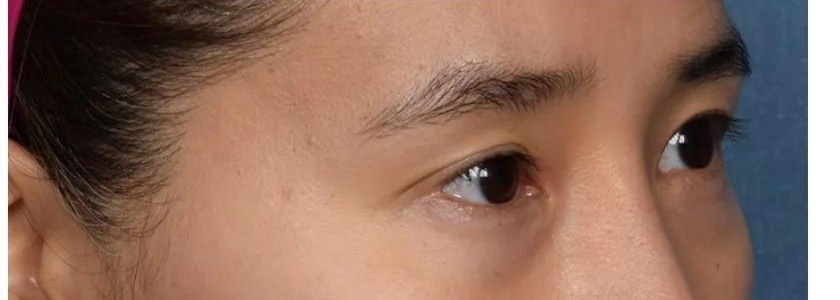
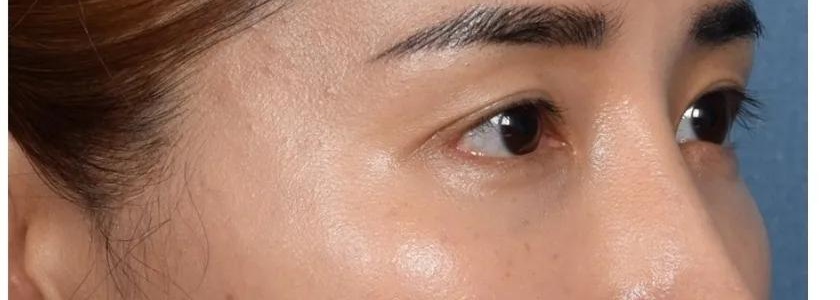
In many younger patients, the puffiness that appears only when smiling is simply a thick strip of pretarsal muscle.
- In parts of East Asia, a modest version of this roll, often called aegyo-sal, is considered attractive because it makes the eyes look youthful and friendly.
- Problems arise only when the roll is very thick, uneven between the two sides or combined with other changes that make it look tired rather than bright.
Early fat prolapse
Orbital fat behind the lower lid may be only slightly forward at rest.
- When the cheek rises and the muscle contracts during a smile, that fat is pushed further forward and can briefly form a visible bulge.
- Over time, the same fat often becomes visible at rest as well, so a bulge that appears only with expression can be an early stage of a classic eye bag.
Lax skin and fine crepiness
Thin or slightly loose skin folds into small pleats when the muscle shortens. In bright light these pleats can look like puffiness, even though very little extra volume is present.
Fluid retention and lifestyle factors
Salt, alcohol, poor sleep, allergies and the menstrual cycle can all add fluid to the lower lid. The area may look normal for most of the day but puffy in the morning or after a late night, and smiling exaggerates that swelling.
How to Tell a Muscle Roll from an Eye Bag
Where the fullness sits, and how it changes, gives useful clues:
- Muscle roll: sits immediately beneath the lashes, follows the curve of the lid margin and has a firm, band-like shape
- Muscle roll: most obvious when smiling and nearly flat when looking upward
- Eye bag: sits lower, closer to the bony rim, and is softer and rounder
- Eye bag: usually more obvious when looking upward, because the fat moves forward
- Home check: take three photos in even light (relaxed, smiling and looking up without moving your head) and compare where the fullness sits
What a Surgeon Will Assess
The surgeon watches the lower eyelid in motion, not only at rest. Expect them to:
- Ask you to smile, squint and look up and down
- Press gently on the upper lid to see whether fat bulges forward below
- Examine skin thickness and elasticity
- Check lower lid tone with a snap-back or distraction test
- Note the lid margin position relative to the iris and the shape of the cheekbone
- Ask about any filler or previous eyelid procedures, which can change how tissue behaves when you smile
Treatment Options by Cause
When the main issue is a thick pretarsal muscle that the patient dislikes, very small doses of a neuromodulator can soften the contraction temporarily.
- This must be done conservatively, because too much can weaken lid support, cause the lower lid to look flat or affect eye closure.
- Many surgeons prefer not to reduce a natural roll at all unless it is clearly disproportionate.
When fat prolapse is the cause, lower blepharoplasty is the more definitive option.
- A transconjunctival approach through the inside of the lid can reposition or reduce the fat without an external scar, which suits patients with good skin quality.
- When there is also loose skin, a small skin pinch or a subciliary incision may be added.
- For mild crepiness without significant fat, skin treatments such as energy-based devices or chemical peels can improve texture modestly.
- Fluid-related puffiness responds best to managing the trigger, whether that is salt, sleep, allergies or sinus congestion.
Why Over-Correction Is a Risk
Because the area changes so much with expression, it can be tempting to remove as much as possible.
- However, removing too much muscle, skin or fat can flatten the lower lid, make the eye look hollow or pull the lid margin downward.
- A small amount of fullness when smiling is normal and often desirable.
- The goal is usually balance and symmetry rather than complete flatness in every expression.
Recovery Considerations
What recovery looks like depends on the treatment:
- Neuromodulator: almost no downtime; results appear over several days and fade over a few months
- Transconjunctival surgery: swelling and bruising typically settle over one to two weeks
- The smile may look a little stiff or uneven for several weeks while the muscle recovers normal movement
- How the lid looks during a smile can usually be judged at around three months
Frequently Asked Questions
Is it normal to have puffiness only when I smile?
Yes. Some fullness under the lashes during a smile is part of normal anatomy and often looks youthful.
Will eye bag surgery remove my aegyo-sal?
Not usually. Fat repositioning works deeper and lower than the pretarsal muscle, so a natural roll is generally preserved unless the plan specifically includes it.
Can this puffiness get worse over time?
If it is caused by early fat prolapse, it may gradually become visible at rest. A muscle roll tends to stay fairly stable.
Planning a Consultation in Seoul
Bring relaxed, smiling and looking-up photos taken in similar light, and tell the surgeon exactly which expression bothers you most. Ask them to point out whether they see muscle, fat or skin as the main cause, and how their plan protects the natural roll that keeps a smile looking friendly.



Transconjunctival vs Skin-Incision Lower Blepharoplasty When You Have Both Fat Bulges and Loose Skin